





Frequently Asked Questions
Frequently asked questions about our products and services.
Installation & Welding
Proper electrofusion welding requires careful attention to the following practices:
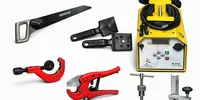
- Pipe Scraping: The oxidised outer layer of the PE pipe must be completely removed using a rotary scraper to expose clean, virgin PE material. Scrape to the depth recommended by the fitting manufacturer.
- Cleaning: After scraping, wipe the pipe and fitting surfaces with a clean, lint-free cloth and approved PE cleaning fluid. Do not touch the cleaned surfaces with bare hands.
- Alignment & Clamping: Insert the pipe into the fitting to the correct depth (marked on the pipe). Use proper alignment clamps to hold the assembly in place, preventing any movement during and after the fusion cycle.
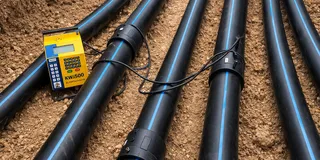
- Fusion Cycle: Connect the EF welding machine and scan the fitting barcode (or manually enter parameters). The machine will automatically apply the correct voltage, current, and fusion time. Do not disconnect during the cycle.
- Cooling: Allow the joint to cool fully in the clamps. Do not disturb or move the assembly until the recommended cooling time has elapsed.
- Inspection: Check fusion indicators (melt witness pegs) to confirm a successful weld.
Re-rounding is the process of restoring an ovalized (out-of-round) PE pipe back to its original circular cross-section.
When is it necessary?
- After coiled pipes are unrolled — coiling causes permanent ovality
- After pipes have been stacked under load during storage
- When pipes show visible flattening from transport or handling
Why is it important?
- Electrofusion fittings require consistent contact between the pipe OD and fitting ID around the full circumference for proper fusion
- Gaps caused by ovality lead to unfused areas, creating potential leak paths
- Compression fittings also need round pipes for the O-ring seal to work properly
Re-rounding is done using a re-rounding clamp or tool that applies gentle radial pressure to restore the pipe's circular shape before fitting assembly.
General
No. Unlike PVC pipes, PE (polyethylene) pipes cannot be joined using solvent cement. PE is chemically resistant to solvents, so solvent welding is not effective.
PE pipes are joined using heat-based fusion methods:
- Butt Fusion: Heating the pipe ends on a hot plate and pressing them together — used for larger diameters (typically 63mm and above).
- Electrofusion: Using EF fittings with embedded heating coils — the most common method for service connections and smaller diameters.
- Socket Fusion: Heating a socket fitting and pipe end, then pushing them together — used in some specific applications.
Alternatively, mechanical compression fittings can be used where fusion equipment is not available, though fusion joints are preferred for permanent, leak-proof connections.
PE pipe segments can be joined using three main methods:
- Butt Fusion Welding: The pipe ends are faced, heated to melting point on a hot plate, and then pressed together under controlled pressure. This creates a strong, homogeneous joint. Suitable for pipes 63mm diameter and above.
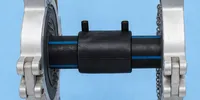
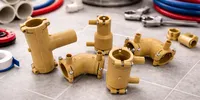
- Electrofusion Welding: A fitting with embedded resistance wire is placed over the pipe ends. Electrical energy melts the PE creating a fused joint. Ideal for service connections, tapping, and repairs. Used for sizes 20mm to 315mm.
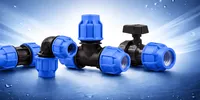
- Mechanical Compression Fittings: A compression ring grips the pipe and an O-ring provides the seal. No special tools or power required. Useful for temporary connections, repairs, and situations where fusion is impractical.
For gas distribution, fusion methods (butt or electrofusion) are mandatory as per safety regulations. Compression fittings are generally permitted for water applications.
Yes. Punctured or damaged PE pipes can be repaired without replacing the entire pipe section. Common repair methods include:
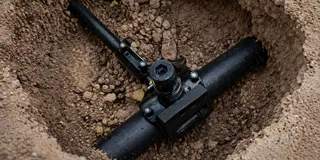
- Electrofusion Repair Saddle: An EF saddle is fused over the damaged area, sealing the puncture with a permanent fusion joint. This is the preferred method for gas lines.
- Squeeze-Off & Coupler Method: For larger damage, squeeze off the pipe upstream and downstream, cut out the damaged section, and join in a new piece using electrofusion couplers.
- Mechanical Repair Clamp: For temporary or emergency water line repairs, a mechanical clamp with gasket can be applied over the damage point.
For gas distribution networks, only fusion-based repair methods are permitted as per safety regulations. Always depressurise the line before attempting any repair.
Electrofusion
The most common causes of electrofusion joint failure are:
- Insufficient Scraping: Failure to fully remove the oxidised outer layer means the EF wire melts into degraded material instead of virgin PE, resulting in a weak bond.
- Contamination: Dirt, moisture, grease, or fingerprints on the fusion zone prevent proper molecular bonding. Always clean with approved solvents after scraping.
- Incorrect Parameters: Using wrong fusion voltage, current, or time can lead to under-fusion (cold joint) or over-fusion (material degradation and blow-out).
- Movement During Fusion: Any disturbance during the fusion or cooling cycle can crack the molten interface. Always use proper clamps.
- Pipe Ovality: Significantly out-of-round pipes may not seat properly in the fitting, causing uneven fusion. Re-round pipes before fitting.
- Power Supply Issues: Voltage drops or interruptions during fusion compromise the joint integrity. Use a dedicated generator if mains supply is unreliable.
Scraping is one of the most critical steps in electrofusion welding. It is necessary because:
- Oxidation Layer: PE pipes develop an oxidised surface layer when exposed to UV light and air. This layer has different molecular properties and cannot fuse properly with the fitting's virgin PE.
- Surface Contamination: During storage and handling, pipes accumulate dust, dirt, and chemical deposits that would interfere with fusion.
- Consistent Fusion Quality: Scraping exposes fresh, clean PE material that bonds molecularly with the melted EF wire coating, creating a homogeneous, leak-proof joint.
Scraping should be performed to the depth specified by the fitting manufacturer, typically 0.1mm to 0.3mm, using a proper rotary hand scraper or mechanical scraping tool. Never use sandpaper or abrasive cloth as this leaves particles embedded in the surface.
Yes. When making a saddle-to-pipe connection using an electrofusion coupler, both the pipe surface and the spigot outlet of the saddle must be scraped.
The spigot outlet of the saddle, like any PE surface, may have an oxidised layer from manufacturing and storage. If this is not removed, the EF coupler joint on the saddle outlet will have the same risks as an unscraped pipe — poor fusion quality and potential leakage.
Follow the same scraping procedure as for pipes: use a rotary scraper, remove the specified depth of material, clean with approved solvent, and avoid touching the scraped surface before fitting assembly.
If power fails or is interrupted during the electrofusion process, the joint must be considered defective and cannot be salvaged.
Reasons:
- An incomplete fusion cycle means the PE has only partially melted, creating an uneven and weak bond
- Re-starting the fusion on the same fitting is not permitted — the wire may have partially melted through its insulation, and re-heating will cause uncontrolled fusion or short circuits
- The fitting cannot be safely re-used as the embedded wire has already been partially consumed
Corrective action: Cut out the entire fitting and affected pipe section. Install a new fitting with fresh, properly prepared pipe ends.
Prevention: Use a dedicated generator or UPS-backed power supply on site, especially in areas with unreliable mains electricity. Modern EF welding machines have built-in voltage monitoring and will alert before starting if supply is inadequate.
Technical
Kimplas TRUSTLENE electrofusion fittings are designed to be SDR independent within their specified size range. This means a single fitting can be used on pipes of the same outside diameter regardless of their SDR (wall thickness) value — SDR 11, SDR 17, or SDR 17.6.
How this works: The EF fitting's bore accommodates the pipe OD, and the fusion zone is on the outer surface. Since pipe OD is constant for a given nominal size (only wall thickness varies with SDR), the same fitting fits all SDR variants.
Regarding PN (Pressure Nominal) Rating:
- The PN rating of the jointed system is determined by the pipe's SDR and material grade, not the fitting alone
- For example: PE-100 SDR 11 pipe = PN 16, PE-100 SDR 17 pipe = PN 10
- The EF fitting provides a joint strength equal to or greater than the pipe itself
- Always match the fitting material grade (PE-80 or PE-100) with the pipe material
SDR stands for Standard Dimension Ratio. It is defined as:
SDR = Outside Diameter (OD) ÷ Minimum Wall Thickness (s)
For example, a 110mm OD pipe with a 10mm wall thickness has SDR 11 (110 ÷ 10 = 11).
Key points about SDR:
- A lower SDR number means a thicker wall and higher pressure rating (e.g., SDR 11 is stronger than SDR 17)
- SDR is independent of pipe size — an SDR 11 pipe has the same pressure rating whether it is 20mm or 315mm diameter
- Common SDR values for PE pipes: SDR 7.4, SDR 9, SDR 11, SDR 13.6, SDR 17, SDR 17.6, SDR 21, SDR 26
Relationship between SDR and PN for PE-100:
- SDR 11 -> PN 16 (16 bar)
- SDR 13.6 -> PN 12.5
- SDR 17 ->PN 10
- SDR 21 ->PN 8
- SDR 26 ->PN 6
Still have questions?
Our team is here to help with any queries about our products and services.
Contact Us